Welcome to My World of Art!
My name is Oravecz Viktória, and I am a painter and visual artist.
Welcome to my website, where I would like to offer you a glimpse into the world that has shaped my life for many years through my paintings, ceramic and textile works, and other artistic creations.
For me, art is not merely about depicting the visible world. It is an exploration of thoughts, emotions, and the deeper connections of human existence. In my work, colours, forms, materials, and different artistic languages come together to create meanings that might never emerge independently.
One of the defining ideas in my art is the concept of coming closer: bringing people, emotions, thoughts, materials, and artistic disciplines closer together. I believe that connections can exist even between things that appear distant from one another, and that discovering these connections can open new paths before us.
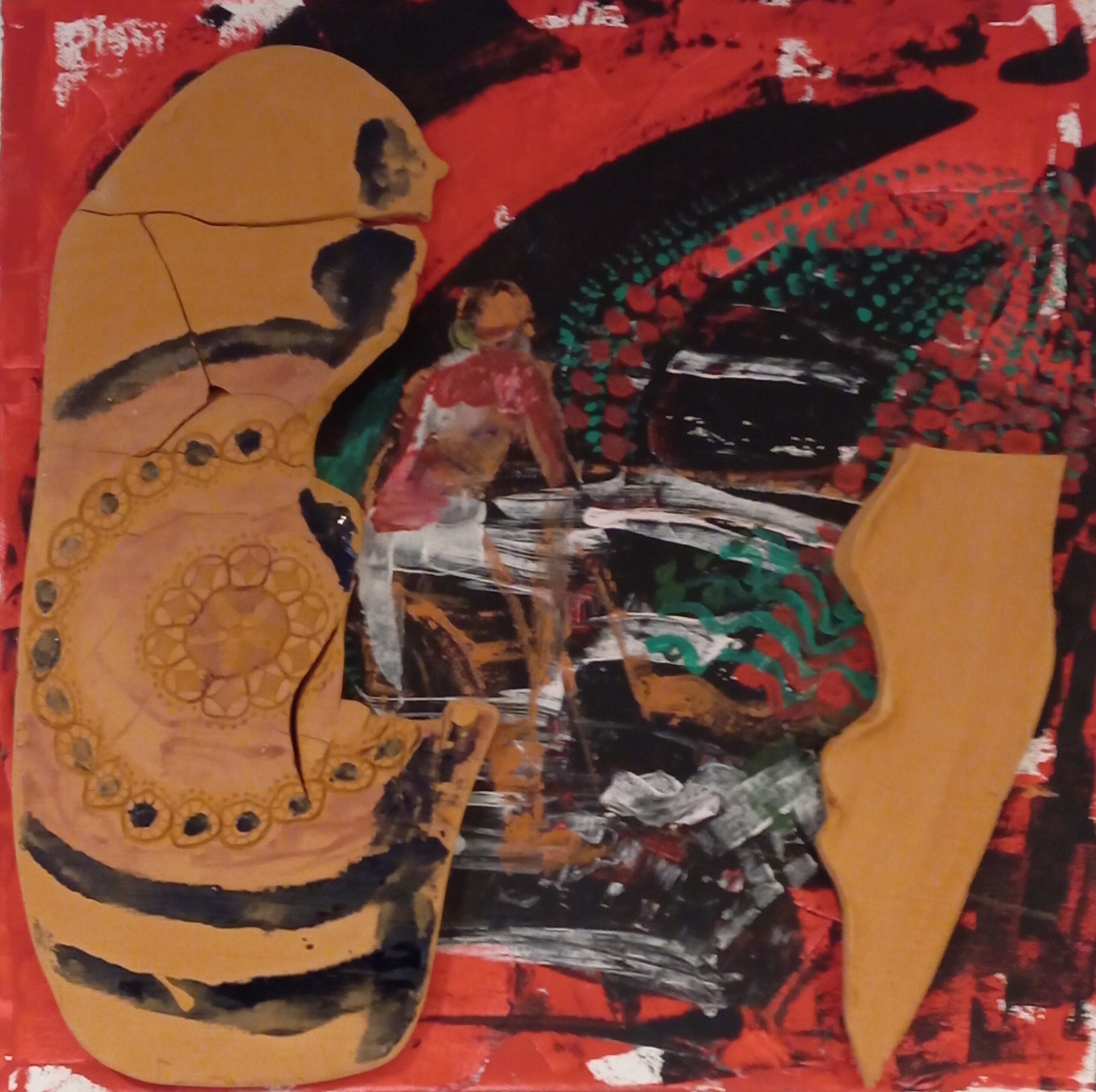
Alongside painting, ceramics, textile and fashion design, poetry, and the relationships between these disciplines have become increasingly important in my work. A painting can find new life in a garment, a poem can give a picture new meaning, and a ceramic element can extend beyond the flat surface to become an integral, three-dimensional part of a painting.
Through my work, I seek to explore new perspectives by moving beyond familiar forms and meanings, while also reinterpreting the values of traditional craftsmanship.
Throughout my artistic career, I have always considered it important to do more than create my own work. I have founded galleries, organised exhibitions, supported fellow artists, and sought to establish community spaces where different creative worlds can meet.
For me, creating art and building artistic communities are two expressions of the same idea: creating connections and bringing people, art, and everyday life closer together.
My Artistic Journey
I was born in Budapest, and my interest in the visual arts began at an early age.
I started my studies at the Secondary School of Fine and Applied Arts in Budapest and later continued my education at the Hetzendorf School of Fashion Design in Vienna, where I studied from 1991 to 1996.
The experience I gained in fashion design continues to influence my artistic thinking. Textiles, cutting patterns, material structures, and the three-dimensional shaping of garments gave me a perspective that later found expression in my paintings and in works combining different artistic disciplines.
My interest in painting gradually grew stronger.
Between 2001 and 2007, I studied painting at the Faculty of Music and Visual Arts of the University of Pécs, where my mentor was the painter László Valkó. Later, from 2008 to 2011, I pursued DLA studies at the same institution, again under his professional guidance.
My years in Pécs were particularly formative. Alongside my painting studies, I had the opportunity to explore different movements in contemporary visual art, experiment with creative techniques, and collaborate with other artists.
My artistic development was also enriched by studies abroad.
In Paris, I attended courses in fine and applied arts, where both French artistic traditions and contemporary approaches influenced me. I also broadened my professional experience in Karlsruhe through an Erasmus scholarship.
The time I spent in France played a particularly important role in the development of my painting. The landscapes, the seaside, the movement of water, and the changing light left impressions that would later return in many of my artistic series.
My experiences in different countries and artistic environments strengthened my belief that creativity cannot be confined to a single technique or artistic discipline.
For me, painting, applied arts, craftsmanship, and poetry are forms of expression that engage in dialogue with one another, enriching my artistic world as a whole.
Artistic Periods – More Than Two Decades of Creative Exploration
My art has continued to evolve over the years.
Each period has brought different themes, materials, painting techniques, and personal experiences to the forefront. Yet these periods are not isolated chapters. Rather, they are stages in an evolving artistic vision, in which earlier experiences repeatedly return in new forms.
Water, movement, human relationships, personal memory, and the interaction of materials have remained recurring themes throughout my work.
2001–2004 | Playing by the Sea
One of the defining early periods of my artistic career is associated with the series Playing by the Sea.
During my studies in France, I became particularly fascinated by the appearance and movement of water.
By the sea, I discovered that water was much more than an element of the landscape. Its constantly changing surface, reflections of light, the rhythm of waves, and continuous movement offered extraordinary emotional and artistic possibilities.
For me, water represented freedom, playfulness, transformation, and an inner experience that was difficult to express in words.
During this period, I became increasingly interested in how the movement of nature, changes in light, and fleeting moments of human presence could be captured through painting.
The works inspired by my experiences at the seaside established the foundations of a visual language that would continue to reappear throughout my career.
Since then, water has returned to my paintings again and again: sometimes as a recognisable landscape, sometimes through abstract forms, and sometimes as a symbol of the changing nature of human life and emotions.
2004–2006 | French Nudes and Landscapes
During the following period, I continued exploring the experiences I had gained in France.
Landscapes, human figures, and nudes appeared in my paintings.
For me, depicting nature and the human body was never merely an exercise in representation. I was searching for relationships between light, colour, bodily movement, and the surrounding environment.
I became increasingly interested in how the meaning of a figure changes depending on the space it occupies, the colours surrounding it, and its relationship with the other elements of a composition.
Alongside figurative representation, freer painterly approaches, stronger colour relationships, and simplified forms gradually became more prominent.
These experiments laid the groundwork for my later, more abstract works.
2005–2006 | Coming Closer
During this period, an idea emerged that would become one of the central themes of my art: coming closer.
In my series Coming Closer, I explored human relationships, distance, and the nature of encounters.
Drawing inspiration from the painting methods of William Turner, I sought to express this idea through the gradual emergence of forms and the blending of light and colour.
In certain works within the series, I depicted myself in the figure of Christ, who moves progressively closer to humanity from one painting to the next.
For me, this approach is not simply a religious or visual narrative, but a deeper human and philosophical question.
Are we truly capable of coming closer to one another? Can we approach others with greater openness, understanding, and acceptance?
The ideas behind this series have continued to influence my work, taking on new forms over the years.
2007–2008 | Baby Swimming
During this period, the recurring motif of water acquired a new meaning.
In the Baby Swimming series, I turned my attention to the beginnings of human life, childhood, and experiences associated with water.
Here, water was no longer simply a natural phenomenon or a source of painterly inspiration. It became an environment associated with human existence, care, and freedom of movement.
Children's movements, bodies immersed in water, and constantly changing forms offered distinctive compositional possibilities.
The relationship between figurative elements and the fluid, difficult-to-define shapes of water further strengthened my interest in representing movement through painting.
2008–2011 | Csenge – Personal Stories and Family Experiences
During this period, my daughter Csenge became the central figure in many of my works.
The paintings inspired by her brought together personal experiences, moments of childhood, and a mother's perspective.
Her movements, games, and small everyday experiences became visual stories that hold both deeply personal memories and broader human meanings for me.
The world of childhood offered particularly interesting artistic possibilities. Playfulness, spontaneity, and freedom of movement connected naturally with my earlier creative interests.
Several works from this period became part of the archives of the Faculty of Music and Visual Arts at the University of Pécs.
The paintings associated with Csenge remain important memories of a time when my personal life and artistic thinking were especially closely intertwined.
2012–2014 | Splash – Water Paintings and Landscapes
During my Splash period, water and landscape once again became central themes.
Earlier seaside experiences, movement, and the changing nature of the natural world found new painterly expressions.
I explored reflections on the surface of water, waves, the fleeting moment of a splash, and the different moods of landscapes.
What particularly interested me was the movement of water and the traces it leaves behind.
A single instant in which the water's surface breaks apart, forms dissolve, and then reorganise themselves can also become a symbol of change and transformation.
During this period, landscape painting increasingly became a means of expressing personal experiences through a freer artistic language.
2015–2016 | Colourful Stripes, the Palace Gardens, and Views from My Balcony
Between 2015 and 2016, compositions based on colourful stripes became a prominent feature of my painting.
The combination of more geometric structures and free painterly expression opened new possibilities for me.
During this time, I created works inspired by the palace gardens in Keszthely, as well as paintings exploring the theme View from My Balcony.
Landscape was no longer necessarily presented as a traditional representation of a view.
Through colourful bands, rhythms, and different visual planes, I explored the structure, atmosphere, and personal significance of what I observed.
This period also includes my painting The Bridge, inspired by a distinctive feature of the palace gardens in Keszthely, which became a symbol of human relationships.
2017–2019 | Scenes of Women
In my series Scenes of Women, the human figure, women's experiences, and personal stories came to the forefront.
Figurative representation once again became more prominent, while colour, compositional structure, and freer painterly approaches continued to play important roles.
For me, the female figures are not merely models or forms to be represented.
They carry emotions, life situations, relationships, and personal stories.
Through these scenes, I sought to capture different moments of human existence while continuing to explore the possibilities of moving between figurative and abstract painting.
2019–2020 | Ceramic Collages on Organic Foundations
During this period, my exploration of the relationship between painting and ceramics gained new momentum.
I began incorporating ceramic elements into compositions built around organic forms.
The meeting of painted surfaces and three-dimensional elements raised new questions for me.
What happens when a painting extends beyond its flat surface? How does a composition change when tangible, physical materials appear alongside painted forms?
The distinctive surfaces, weight, fragility, and three-dimensional nature of ceramics added new layers of meaning to my work.
Organic forms and the natural properties of materials became increasingly important in my artistic thinking.
2020–2024 | The Fish Series and “Wear My Painting!”
During this period, I explored two artistic directions that could also be connected to one another.
The Fish Series represented a new interpretation of my earlier themes associated with water and the natural world.
The shapes and movements of fish, together with the forms of aquatic life, created a distinctive visual language in which both figurative and abstract elements played a role.
At the same time, textile and fashion design once again became more prominent in my work.
The ideas behind The Sewn Coat and “Wear My Painting!” explore the relationship between painting and wearable art.
A painting can find new life in a garment, an image can emerge from the fabric of a coat, and a poem can become part of the work.
In this way, the artwork can move beyond its conventional environment and become part of everyday life.
For me, “Wear My Painting!” is both a play on words and an artistic concept.
It suggests that art does not necessarily have to remain an object hanging on a wall. It can continue to exist in another material, another form, or even as something that can be worn.
2025–2026 | Geometric Compositions and Ceramic Collages
In my most recent works, the relationship between geometric structures and freer, organic ceramic forms has come to the forefront.
The foundations of these paintings often consist of clearly defined geometric shapes, colourful surfaces, and carefully structured compositions.
These are combined with three-dimensional ceramic elements that introduce new rhythms, depth, and material qualities.
I am particularly interested in the tension between geometric order and organic forms.
The interaction between flatness and space, regularity and freedom, painted surfaces and hand-shaped materials creates new artistic possibilities.
In my ceramic collages, cut-outs, raised elements, surface differences, and the natural properties of materials have become increasingly important.
These works also carry the experiences of my earlier artistic periods.
In the meeting of painting, ceramics, geometry, and organic forms, one of the fundamental ideas of my art reappears: bringing different worlds closer together and connecting them.
Colours, Forms, and Materials – From Flat Surfaces to Three Dimensions
Painting lies at the heart of my creative work, but I have always been fascinated by possibilities that extend beyond traditional painting techniques.
I work with acrylic and oil paints, often using canvas or fibreboard as my support.
Both figurative representation and abstraction are present in my work.
Alongside recognisable figures and stories, simplified geometric shapes, expressive gestures, rhythmic lines, and the interaction of different surfaces have become increasingly significant.
I am particularly interested in the relationship between painting and ceramics.
In some of my works, ceramics do not appear as independent objects but become an integral part of the painting itself.
Ceramic reliefs attached to canvas or fibreboard extend beyond the picture plane, creating new effects of light and shadow and unusual visual relationships through their three-dimensional presence.
Sometimes a figure, such as the head of a fisherman, appears as a ceramic form positioned within a cut-out section of the painting's background.
In such cases, the painted surface, the opening, and the three-dimensional element together form the composition.
The meeting of geometric order and freer, gestural ceramic forms creates a distinctive tension.
Materials, cut-outs, raised elements, and contrasting surfaces establish new visual systems in which the traditional concept of a painting is itself reinterpreted.
Cracks, damage, and fragmentation in ceramics are not necessarily flaws to me.
Often, these very qualities become essential carriers of meaning within the artwork.
Just as pain, challenges, mistakes, and learning from experience are part of human life, the vulnerability of a material can express the complexity of existence.
Fragmentation may suggest not only decay but also transformation, reinterpretation, and the possibility of rebirth.
When Painting, Textiles, and Poetry Meet
The connection between different creative disciplines has become an increasingly defining feature of my art.
For me, textile and fashion design are not merely forms of applied art but integral parts of my artistic thinking.
I see special possibilities in bringing together a painting, a garment, and a poetic idea.
A picture may emerge from the fabric of a coat, accompanied by a poem.
At other times, the ideas behind a painting may continue in a wearable garment, or the garment itself may offer a new interpretation of the image.
For me, “Wear My Painting!” is both a play on words and an artistic possibility.
It suggests that a painting does not necessarily have to remain an object hanging on a wall, intended only to be observed.
It can continue to exist in another material, another form, or even as a wearable work of art.
The artwork can therefore enter into a new relationship with people: we do not merely look at it, but use it, wear it, and make it part of everyday life.
Poetry also plays an important role in my artistic thinking.
A poem, a title, or even a single word can enrich an image with new layers of meaning.
What particularly interests me about the meeting of wordplay, poetic imagery, and visual forms is the moment when a familiar meaning changes and the artwork offers new possibilities for interpretation.
A thought can become a poem, a poem can become an image, an image can become a three-dimensional form, and that form may eventually become a garment or a ceramic artwork.
For me, this process represents creative freedom.
At the same time, it is also a return to craftsmanship and tradition—not through simple repetition, but through reinterpretation.
A contemporary approach to traditional materials and techniques offers possibilities in which the experiences of the past and the artistic questions of the present enrich one another.
Coming Closer – The Philosophy Behind My Art
One of the recurring themes in my work is the nature of human relationships.
I am interested in how we come closer to one another, how we drift apart, and how we might rediscover connections that have weakened or been broken during our lives.
The idea of coming closer was already present in my earlier paintings.
In my series Coming Closer, I drew inspiration from William Turner's painting methods, expressing this idea through the gradual emergence of forms.
In certain works within the series, I depicted myself in the figure of Christ, who moves progressively closer to humanity from one painting to the next.
For me, this approach is not simply a visual narrative but a deeper human and philosophical question.
Are we truly capable of coming closer to one another?
Can we approach our fellow human beings with greater openness, understanding, and acceptance?
The ideas behind this series have continued to live on in my work, taking on new forms and interpretations.
Coming closer does not happen only between people.
The past and the present, tradition and innovation, painting and ceramics, images and poetry, thoughts and their material expressions can also move closer together.
In my art, these encounters create new meanings.
Reinterpreting symbols, exploring philosophical questions hidden within everyday scenes, and changing familiar perspectives have become defining aspects of my artistic journey.
I believe that one of art's greatest possibilities is that it allows us to see ourselves from a different perspective.
We may recognise our mistakes, reconsider our decisions, and perhaps interpret situations differently that we once believed could never change.
The Bridge – Connections and Encounters
The ideas of coming closer and creating connections play a particularly important role in my painting The Bridge.
The work was inspired by a bridge in the palace gardens of Keszthely, which represents much more to me than a landscape motif.
A bridge connects two shores, but symbolically it can also connect people who have grown apart, different thoughts, and different situations in life.
I painted the 160 × 140 cm work on canvas in 2015–2016, when I was invited by the management of the palace in Keszthely to work as a painter in the palace gardens.
The large-scale composition, built around colourful bands, developed on location.
The surrounding environment and the human encounters I experienced there became part of the creative process.
I particularly remember a conversation with a child while I was working on the painting.
In a remarkable way, this encounter reflected the idea behind the artwork: the bridge existed not only within the painting but also in the personal meeting, the conversation, and the act of turning towards one another.
I had also previously been involved in professional discussions connected with the palace in Keszthely.
I participated in round-table discussions where we exchanged ideas and proposals for future development.
Later, in Hévíz, I was invited by the city's leadership to present my thoughts and suggestions, some of which subsequently began to be implemented.
These experiences strengthened my belief that art does not necessarily end at the walls of the studio.
Creating, thinking, and engaging in human dialogue can be mutually enriching processes.
Founding Galleries and Building Artistic Communities – In the Spirit of Shared Creativity
Throughout my artistic career, I have always considered it important not only to create my own work but also to provide opportunities for other artists to exhibit, exchange ideas, and collaborate.
I believe that art is not exclusively an individual activity.
When artists meet, discover one another's work, organise exhibitions, and engage in conversation, they can create an intellectual and creative environment in which new ideas and artistic relationships emerge.
With this philosophy in mind, I founded and operated galleries in Keszthely, Pécs, and Hévíz, organised exhibitions, supported artists, and helped artistic communities develop.
Kirak-Art Gallery – Keszthely, 2006–2008
In 2006, I founded the Kirak-Art Gallery at 3 Bem József Street in Keszthely.
The gallery was housed in a stylish building more than a hundred years old, a place that also held personal family memories.
My parents had previously used the building as a dressmaking salon.
It was particularly meaningful to me to establish an art gallery in a place whose history was already connected with craftsmanship, creativity, and the shaping of materials.
Alongside my own work, we exhibited paintings by my then-partner, Zoltán Somogyi.
Together, we sought to create an exhibition space in Keszthely dedicated to contemporary visual art.
At that time, such an initiative was something new in the city's artistic life.
I feel that by founding the Kirak-Art Gallery, we helped open new opportunities for presenting contemporary art in Keszthely.
We wanted not only to show our own work but also to represent an artistic outlook open to new creative approaches and encounters between different artistic movements.
The gallery operated at this location from 2006 to 2008.
Gyümölcsöző Dessert Bar – Art Lives On
In 2008, I leased the premises in Keszthely, and a hospitality venue called Gyümölcsöző Desszertbár began operating in the building.
Although the gallery's original form of operation changed, I considered it important that the location should remain connected to the visual arts.
As a result, my work remained on permanent exhibition at the dessert bar until 2011.
This period strengthened my belief that art does not necessarily have to be presented in traditional galleries.
A café or another community space can also offer opportunities for people to encounter paintings and other artworks in their everyday lives.
In this way, art can become a more natural part of life.
Művész Café – The Birth of a Contemporary Artistic Community
Later, in Keszthely, I founded and managed the Művész Café exhibition space, which became one of the most important community-building initiatives of my artistic career.
At Művész Café, I did not exhibit only my own work.
I regularly organised exhibitions for other visual artists, providing opportunities for their work to reach a wider audience.
Supporting artists at different stages of their careers was particularly important to me.
Exhibiting artists included Xénia Tóth, Zsófia Herman, Attila Olasz, Csongor Horváth, Valéria Szép, Helga Borbás, and the sculptor Aliz Hermán, among others.
A Japanese artist, Tomboló Fujinaga, also exhibited at the venue.
I was able to provide exhibition opportunities for several artists who later became more widely recognised.
I had known Helga Borbás since our university years in Pécs, and these professional and personal connections also contributed to organising exhibitions.
Together with András Farda, I established a shared studio, and we organised exhibitions together.
Through my work, I supported artists, collected paintings, assembled exhibition materials, and sought to create the conditions in which artists could present their work.
However, Művész Café was not devoted exclusively to the visual arts.
Music also played an important role in the life of the venue.
Well-known bands rehearsed in the basement beneath the café, and musical performances were also held there.
In this way, representatives of the visual arts and music could meet within a shared cultural space.
For me, Művész Café was much more than a café or exhibition venue.
I wanted to create a community space where artists, art lovers, and visitors could meet informally, talk, and discover one another's ideas.
I feel that this initiative helped contribute to the development of a more vibrant contemporary art scene in Keszthely.
The idea of combining art and hospitality was later adopted by other local establishments.
What matters especially to me is that these initiatives resulted not only in exhibitions but also in lasting personal and professional relationships.
Pajti Café – Continuing the Artistic Tradition
Today, Pajti Kávézó operates in the former Művész Café premises.
I leased the property to its current operators, and I am delighted that its artistic character has been preserved.
A permanent exhibition of my work can still be seen at the café.
For me, this represents a special sense of continuity.
The location that once served as a gallery, exhibition space, and meeting place for artists continues to offer visitors the opportunity to encounter visual art as part of everyday life.
The story of this place has therefore not ended for me; it continues in a new form.
Kirak-Art Gallery – Pécs, 2008–2011
Alongside the gallery in Keszthely, I also founded my own exhibition space in Pécs.
Between 2008 and 2011, I operated the Kirak-Art Gallery at 7 Ferencesek Street, in an inner courtyard accessible from the street.
This period coincided with my DLA studies at the Faculty of Music and Visual Arts of the University of Pécs.
I regularly organised exhibitions at the gallery, creating opportunities to present both my own work and that of other artists.
The artistic environment in Pécs was particularly inspiring.
My studies, creative experimentation, professional discussions, and gallery management became activities that reinforced one another.
Here, too, the Kirak-Art Gallery meant more to me than simply an exhibition venue.
It was a space where different creative ideas could meet and where art could establish a direct relationship with its audience.
Oravecz Viki Gallery – Hévíz, 2015–2026
In 2015, I also founded my own gallery in Hévíz, which operated under the name Oravecz Viki Galéria until 2026.
The gallery was an important venue for presenting my own work and organising exhibitions.
During my years in Hévíz, I continued to pursue the idea that art should not be present only through exhibited objects but should also create personal encounters and professional relationships.
At the gallery, I was able to present different periods of my painting and other visual art practices while also helping fellow artists introduce their work to the public.
My experiences in gallery management further strengthened my conviction that the development of an artistic community requires not only artists but also initiators, organisers, and shared cultural spaces.
Art as a Force for Building Communities
My experiences in founding and managing galleries are closely connected to one of the central ideas of my art: coming closer.
Just as I connect different materials, forms, and artistic disciplines in my work, I have also sought to bring people, ideas, and creative worlds closer together through my community activities.
For me, a gallery has never been merely a collection of walls and exhibited artworks.
It has always been a meeting place where art can give rise to new relationships, collaborations, and shared experiences.
I consider it particularly important that I was able to help initiate contemporary artistic activities in Keszthely that were innovative within the city's cultural life at the time.
The Kirak-Art Gallery, Művész Café, and the exhibition opportunities that followed all expressed my desire to bring art closer to people.
I believe that one of art's most important roles is not only to interpret the world but also to encourage dialogue between people.
This philosophy continues to shape both my artistic and personal outlook today.
Exhibitions and Professional Recognition
For more than two decades, I have presented my work in solo and group exhibitions, both in Hungary and internationally.
My work has been exhibited in Budapest, Pécs, Keszthely, Hévíz, Szentendre, Szeged, and Zalaegerszeg, among other locations, as well as at various exhibition venues abroad.
Throughout my artistic career, I have had opportunities to gain professional experience and present my work in Austria, Germany, France, and Belgium.
My exhibitions have included painting series exploring landscapes, human relationships, and personal experiences, as well as presentations of ceramics and experimental three-dimensional works.
Important professional milestones have included exhibitions associated with the University of Pécs, the Színerő programmes, and exhibitions organised by various artistic associations and creative communities.
One of the significant recognitions of my career was second place in the POSZT Painters' Competition in 2009.
My studies and artistic development were also supported by an Erasmus scholarship and a Hungarian Republic Scholarship.
Several of my works have entered public and private collections, including the collection of the Pécs Gallery and the archives of the Faculty of Music and Visual Arts at the University of Pécs.
I also participate in the work of artistic communities. I am a member of the Közelítés Association, the Vitrin Association, and the Association of Hungarian Creative Artists (MAOE).
In recent years, my artistic interests have increasingly focused on connecting different artistic disciplines.
In 2025, I presented my work in Gyenesdiás under the title New Textures, and in 2026, my creations were also featured in the Valley of Arts Festival in Kapolcs.
These exhibitions provided further opportunities to introduce audiences to works emerging from the interaction of painting, ceramics, and different materials.
Continuous Creation – Searching for New Paths
My artistic interests have continually evolved and expanded over the years.
From my experiences by the sea, the movement of water, and landscape painting, I gradually moved through human relationships and personal stories towards connecting different materials and artistic disciplines.
Moments of childhood, scenes of women, motifs inspired by Lake Balaton and the seaside, geometric structures, and ceramic collages are all different stages of a longer artistic journey.
Although my themes and techniques have changed, certain fundamental questions have accompanied me throughout my career.
How can movement be captured?
How can a personal memory become a universal human story?
How can nature and humanity, painted surfaces and three-dimensional forms, traditional craftsmanship and contemporary visual art be connected?
In my more recent works, the relationship between painting, ceramics, textiles, and poetry has become particularly important.
Moving from two dimensions into three, using traditional materials in unexpected ways, bringing geometric and gestural forms together, and crossing the boundaries between different artistic disciplines are all creative possibilities that lead me towards new questions and discoveries.
For me, art is a continuous process of exploration.
It is curiosity about what happens when a familiar form is placed in a different environment, when an object acquires a new function, or when an idea is expressed not through a single artistic language but through several forms of expression working together.
I believe that countless possibilities in art remain unexplored.
When creating, I do not necessarily seek ready-made answers.
Instead, I want to raise questions that encourage thought, discovery, and a renewed understanding of ourselves.
For me, art offers an opportunity to move beyond our familiar perspectives and look at the world, at one another, and at ourselves with fresh eyes.
Perhaps this is what matters most: coming closer to what we do not yet understand, and coming closer to one another.
You Are Warmly Invited into My Artistic World
Thank you for visiting my website.
I warmly invite you to explore the paintings, ceramic and textile works, and other creations presented in my gallery.
Discover the colours, forms, ideas, and stories within them that speak to you personally.
I hope that through my work, you will not only come closer to my artistic world but perhaps also discover new paths towards your own thoughts, memories, and emotions.
Oravecz Viktória
Painter and Visual Artist